




Difference Between Ergonomic Chair and Regular Office Chair
Difference Between Ergonomic Chair and Regular Office Chair
The difference between an ergonomic chair and a regular office chair goes beyond appearance. Both types of chairs can provide a place to sit at a desk, but ergonomic chairs are generally designed with greater attention to adjustability, body support, sitting posture, and long-duration use.
For hotels, offices, coworking spaces, business centers, and commercial interiors, understanding these differences can help designers, developers, and FF&E procurement teams select seating appropriate for the intended environment.
What Is a Regular Office Chair?
A regular office chair typically provides basic functions such as a seat, backrest, swivel base, casters, and seat-height adjustment. Some models may also include armrests or a tilt mechanism.
The design is often focused on straightforward functionality and cost efficiency. A basic office chair can be suitable for occasional desk use where users do not spend long periods working at the workstation.
However, adjustment options may be limited. The backrest, seat depth, armrests, and lumbar area may have fixed dimensions, meaning the chair may not accommodate different users equally well.
What Is an Ergonomic Office Chair?
An ergonomic office chair is designed around the relationship between the chair and the user's body. It typically offers more opportunities to adjust the chair to individual preferences.
Depending on the model, an ergonomic chair may include:
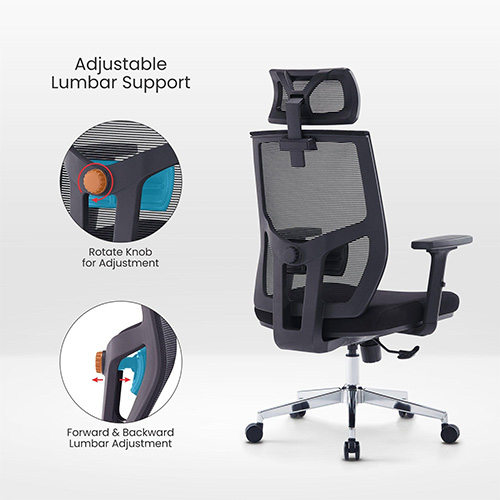
- Adjustable lumbar support
- Adjustable seat height
- Adjustable seat depth
- Adjustable armrests
- Adjustable headrest
- Reclining backrest
- Tilt-tension adjustment
- Synchronized seat and back mechanism
- Height-adjustable or flexible backrest
- Five-star swivel base and casters
These features allow users to modify the chair according to their body size, desk height, and preferred working position.
Ergonomic Chair vs. Regular Office Chair
The biggest difference is adjustability.
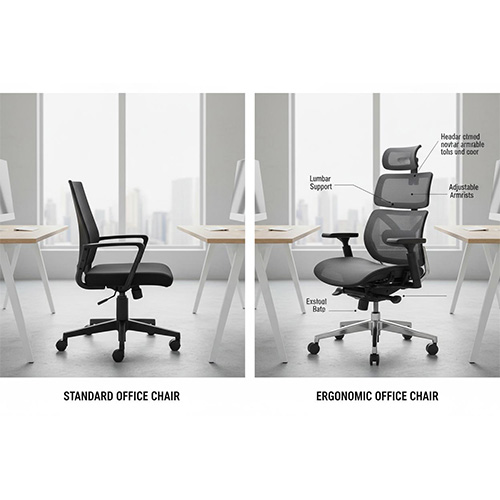
A regular office chair may have a fixed backrest and basic height adjustment, while an ergonomic chair can provide several independent adjustment points. This makes an ergonomic model more adaptable when a workstation is shared by different users.
For example, adjustable lumbar support allows the lower-back support position to be modified. Adjustable armrests can help users position their arms more comfortably relative to the desk. Seat-depth adjustment can help accommodate users with different leg lengths.
However, more adjustment does not automatically mean that every ergonomic chair is suitable for every user. Chair dimensions, adjustment ranges, mechanism quality, and individual preferences should all be considered.
Backrest and Lumbar Support
The backrest is another important distinction. Regular office chairs may use a relatively simple vertical back, while ergonomic chairs often use a contoured backrest designed to provide more comprehensive support.
Lumbar support can be integrated into the backrest or provided through an adjustable mechanism. Some chairs use mesh backrests for breathability, while others use molded foam or upholstered panels.
For commercial projects, designers should consider both ergonomic characteristics and the visual requirements of the interior.
Seat Design and Comfort
Ergonomic chairs often provide more carefully engineered seat cushions. Seat depth, cushion density, edge profile, and seat pan shape can all influence comfort.
A regular office chair may use a standardized seat dimension that works adequately for general use but offers less flexibility.
For long-duration computer work, a chair with adjustable seat height and appropriate seat depth can provide greater flexibility than a fixed-dimension chair.
Which Chair Is Suitable for Hotels?
Hotels frequently use desk chairs in guest rooms, business centers, executive offices, and meeting rooms. The appropriate chair depends on how the space will be used.
A regular commercial desk chair may be suitable for a guestroom where guests typically use the desk for short periods. An ergonomic chair may be more appropriate for executive offices, hotel management offices, coworking areas, and business centers where users may work for extended periods.
Hotel designers should also consider chair size. A highly adjustable executive ergonomic chair may be excellent for an office but visually oversized for a compact guestroom.
Durability and Maintenance
For hospitality and commercial environments, durability is just as important as ergonomics. Chairs should be evaluated for frame construction, mechanism quality, caster durability, upholstery performance, weight capacity, replacement components, and warranty support.
Mesh chairs can offer breathability and a contemporary appearance, while upholstered or synthetic-leather chairs can provide a more traditional hospitality aesthetic.
The difference between an ergonomic chair and a regular office chair is primarily the level of adjustability and the extent to which the chair is designed around different users and working positions.
Regular office chairs can provide practical seating for general or occasional desk use. Ergonomic chairs typically offer additional adjustment features such as lumbar support, seat-depth adjustment, adjustable armrests, and reclining mechanisms.
For hotel and commercial FF&E projects, the best choice depends on the room function, expected usage, available space, design concept, durability requirements, and project budget. A thoughtful specification can balance ergonomic functionality with the visual and operational requirements of the hospitality environment.
Latest News
Contact Us

Mobile: +86-18750258798
E-mail: [email protected]
Add: Unit 6025 Minnan Town A No 350 ChangLe Huli District 361006 Xiamen Fujian Province China


 Mail inquiry
